Background
This report follows the veterinary assistance and advice provided to LG Farm, a tenanted farm with two young new entrants to farming who established their grazing-focused dairy farming operation in early 2022. Established in May 2022, eighty Holstein x Jersey Autumn calving dairy cows were bought in, mainly from Ireland. Further purchases brought the milking herd to around 210, with a mix of Spring and Autumn calving cattle. Aside from the two partners in the business working on farm, there was one regular employee, and one or two shorter-term workers on farm at any one time.
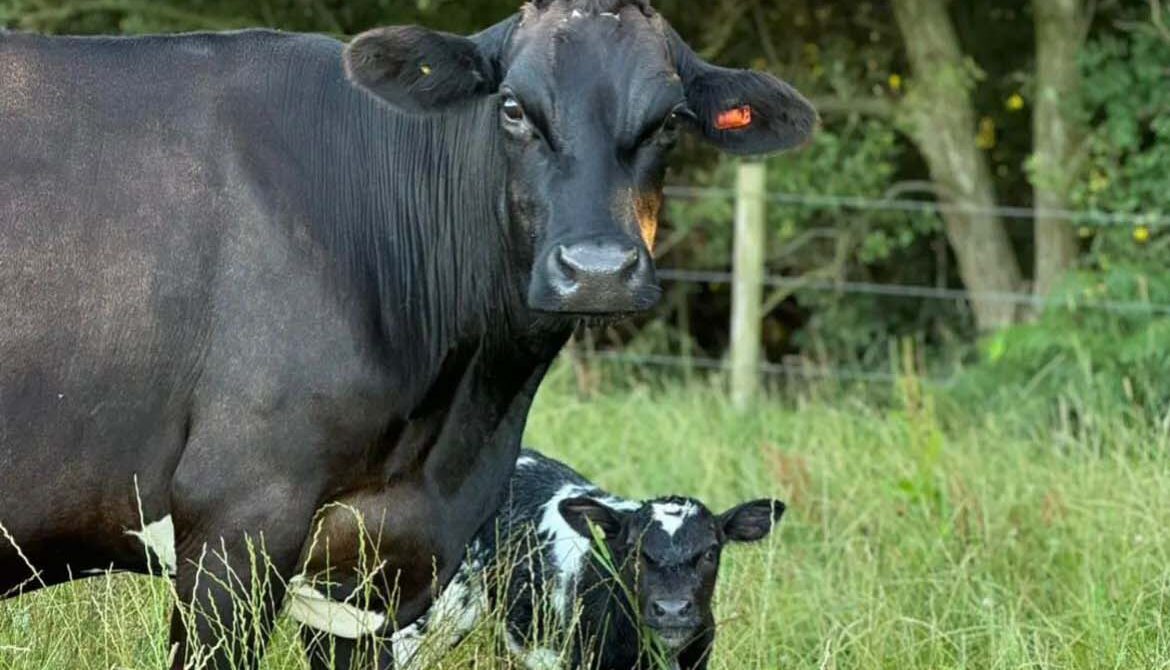
Alongside the consultation involved in the new herd setup, a key ambition of LG Farm was to run the dairy cattle with calves at foot to three weeks old; this, alongside improving calf health and management, are the focus of this case report.
Challenge
There were several challenges to overcome with suboptimal calf management leading to failure of passive transfer, increased disease incidence, losses and poor performance amongst the calf crop. This came to a head in late 2023 with a severe outbreak of scour due to Cryptosporidium, with concurrent pneumonia due to a combination of RSV and Mycoplasma (Pasteurella also involved secondarily). By this stage calving was near year-round, the 2023 calves were bucket reared, weaned from their dams at 24 hours old and transferred to a neighbouring farm. LG Farm also experimented with one group of calves kept on cows on a half-on/half-off system (with cows at grass during the day, off overnight with calves in a straw shed, cows in cubicles). They observed increased stress in these cows, who spent the separated periods calling for calves instead of eating and ruminating, with associated loss of body condition and difficulties in milk let down in the parlour.
|
Calf ID |
Brix (>8.5% = adequate) |
ZST (>19 = adequate) |
Result |
|
222 |
6.5% |
3 units |
Absolute failure |
|
225 |
7.9% |
18 units |
Relative failure |
|
213 |
6.9% |
11 units |
Relative failure |
|
224 |
7.1% |
15 units |
Relative failure |
|
214 |
6.5% |
11 units |
Relative failure |
Table 1. Summarising blood test results undertaken on five randomly selected calves, aged 3-5 days old, from the 2023 calf crop. Brix was performed on farm, measuring the percentage total protein in blood serum using a handheld Brix refractometer. Blood samples were then sent to the lab for independent analysis, run for Zinc Sulphate Turbidity (ZST). All sampled calves demonstrated failure of passive transfer.
Additionally, Johne’s prevalence amongst the milking herd was approximately 5%, and Neospora had been identified as a cause of abortion in 2 cows. While not directly contributing to the challenges of poor calf health at this stage, they were factors to consider for longer-term calf management and selection.
Objectives
LG Farm wanted to implement an ethical and profitable calf-rearing operation, to facilitate a more natural cow-calf bond by rearing the calves on their mothers for the first 3 weeks of life before weaning. With this goal in mind, the objectives of our consultations from late 2023-24 were:
- Reduce calf disease incidence to <5%, with a focus on optimising colostrum management.
- Establish a tight Autumn calving block, ideally <9w.
- Preserve the profitability of milk production from the dairy herd.
- Enhance the profitability of calf sales.
- Produce a healthy, even crop of well-grown calves to be weaned from cows at three weeks old.
Plan and implementation
-
- Colostrum management
Every cow’s colostrum was sampled upon calving and checked using a digital Brix refractometer to remove variation in interpretation between operators. The target we used was 25%. For colostrum qualities falling below this threshold, we either collected the dam’s colostrum and supplemented it with powdered colostrum to reach a Brix of 25%, or fed from frozen supplies of previously collected and tested stores. With an extensive vaccination programme taking place, it was a priority to ensure the transfer of maternal antibodies to calves was achieved. Calves were to be subjectively assessed for thriftiness at birth, and ease of calving was scored (0 – no help, 1 – minor assistance, 2 – moderate-major aid). Thrifty calves with calving scores of 0 -1 were to be allowed to suckle themselves; those born following harder calvings, score 2, were to be assisted to suckle, or fed with a bottle/tube, depending on the most appropriate action. - Housing design and management
Address obvious flaws in housing design, specifically the avoidance of calves in wet, flooded areas. The use of straw bales to provide windbreaks and reduce rain ingress into the shed. Adjoining the main shed is an approximately five acre field, which was divided into roughly one acre calving paddocks which could be rotated between to reduce the build-up of pathogens and preserve grass cover. This facilitated outdoor calving while maintaining the capacity for close observation. - Calf/Cow management
Cows grazed on a rotational system (already established) with calves at foot run as a separate group. Brought in for once daily milking, and calves separated in the yard before being reunited post milking. Calves to be weaned from cows at three weeks old, and transfer to automatic milk feeder, or be sold.
- Colostrum management
Limitations
Housing and infrastructure were the main limiting factors. There was no chance of investment to improve buildings or layout on farm. Labour availability and skills/experience were variable and provided a challenge in terms of continuity of protocols. Disease circulation on farm following the relatively large influx of animals in a short period of time was still a concern, risk of pneumonia in calves was seen as a particular concern.
Outcomes
The calving block was tightened to 11 weeks, not quite achieving the nine weeks target, but an improvement on the spread of the year before. Unfortunately, eight weeks into calving, weather conditions forced housing, with a change in calf management. The first ~150 calves were calved outside and kept at foot, with the final ~60 separated from the dams under 24 hours old and reared on an automatic milk feeding machine. With two groups of calves from one calving to compare, this provided a good opportunity to compare the two methods of calf rearing on this farm for this calving period. Average birth weights of calves were between 30-40kg, and initial colostrum management was the same for all calves; the majority of colostrum BRIX testing provided values of 26-27%.
|
Calves on cows, outside |
Calves on powder, inside |
|
|
% Calves treated – pneumonia |
2% |
~ 30% |
|
Average Weight at 3 weeks old |
70 – 90kg |
45 – 55kg |
|
Av. Estimated milk intake |
10-15 L/day |
7 L/day |
|
Av. Peak Milk yield |
27 L |
25L |
|
Av. Butterfat / Protein |
3.99% / 4.94% |
3.59% / 4.73% |
|
Av. SCC |
110,000 cell/ml |
180,000 cell/ml |
Significantly to LG Farm, in 2024 they forged a deal to supply a calf rearer, selling their three-week-old weaned suckled beef calves at £350/head, a substantial improvement on the average of £250/head for milk powder reared calves at eight weeks old that they had been achieving in 2022/23.
Perceived labour and inputs, while not specifically recorded, were deemed to be reasonably equivalent between the two systems at LG Farm. Compared to the previous years when they attempted calves being half on/off the cows, they commented that labour inputs under that system were much higher.