Ruminant Revival's collaboration day
When a farm vet is called out, the problems they encounter usually trace back to three things, or a combination of them:
- Genetics, and whether the animal is suited to that system in the first place;
- How stock is managed, and how the farmer carries out the work;
- Nutrition – what the animal is eating, when and where.
Get those right at the outset, and much of the reason to pick up the phone disappears. Ruminant Revival was built on that idea, and it shaped our collaboration day at Cairns Farm in West Lothian on 8 July, where founder Lee-Anne Oliver made the case that better systems prevent more disease and ultimately lead to greater productivity and profitability.
Agricultural communicator and Nuffield scholar Wallace Currie, host of the R2Kast podcast, chaired the day and made the case that the sector’s challenges are shared and facing them alone is a mistake. To that end, we brought around 60 beef and sheep producers, processors and industry bodies together for an invitation-only day of talks and workshops, on the premise that there are plenty of events debating what should be done and far fewer where the people who can act on good ideas sit in the same room.
National Beef Association chief executive Neil Shand opened the formal sessions on the volatility challenge and how little control beef producers have, from input costs climbing to trade disruption, including the situation in the Middle East. Devolution has spread different support packages across the UK in ways shoppers never see, he argued, while retail price wars have severed links between farm prices and supermarket shelves. He also warned of disease crossing borders, with Bluetongue now recorded further north than before, into southern Scotland, and illegal meat imports a route for the next incursion. Sheep farmer Derek Hall, of the NSA Scottish region, made the case for genetic diversity as an asset in its own right, and James Biggar of the Chapelton herd described successful breeding, using 50,000 data points across 12,000 animals to produce cows that get in calf and get on with the job!
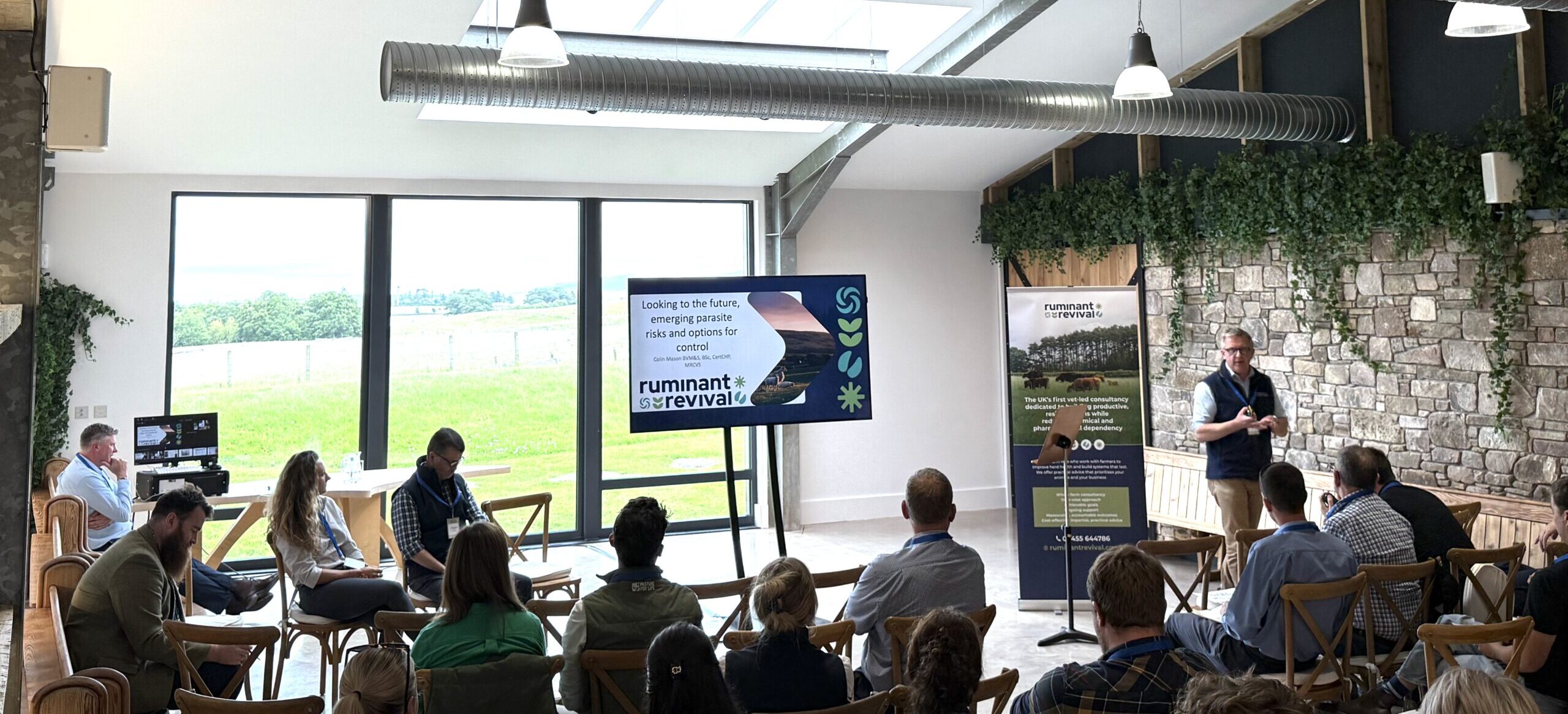
New Zealand vet Grace Boardman, who described bringing the DAGI drench and grazing app to market, pointed out that New Zealand publishes annual parasite surveillance reports and Britain publishes none, so farmers here are treating half-blind, and by the time a faecal egg count shows a burden, the lost growth is already gone. Moredun’s Philip Skuce and Ruminant Revival consultant Colin Mason set out a picture shifting with the climate, from Barber’s Pole Worm overwintering on pasture to ticks as one of the fastest-moving risks of all. Monitoring over routine dosing was the suggested solution, where a lamb growing well may not need worming at all.
Lee-Anne pointed to one farm she advises that has cut input spend by 90 per cent through mob grazing and rotation. In a wide-ranging session on grazing, chaired by consultant and crofter Emily Grant, virtual fencing ran through the farm accounts, from conservation grazier and film-maker Sam Firth’s outwintered cattle at Rhemore Croft reaching ground down to the shore, to Callum Wylie growing an antibiotic-free organic dairy herd at Torr Farm on land the collars had opened up.
Planning for Profit’s Samantha Charlton argued that until a farmer knows the gross margin on each unit of production, they cannot see which work is carrying the business and which is draining it. QMS board chair Kate Rowell reported prime cattle prices still 23 per cent above 2024, with shoppers buying less but better, from scratch cooking up around 10 per cent, protein in demand (partly to offset the muscle loss from GLP-1 drugs), and many wanting to buy local without knowing what to ask the butcher for. Butcher and farmer Jock Gibson addressed the quality question from the production side, arguing that the factor trumping flavour, tenderness and nutrient density is availability, with red meat now out of reach for some households. Britain runs 73 cattle breeds, where most South American countries manage on two, he noted, yet it expects a consistent result, and the stress of handling and transport drains the muscle glycogen that separates good beef from dark, tough meat.
Susi Stuehlinger of the Scottish Crofting Federation set out the moveable sheep-and-goat abattoir being trialled in Orkney, and regenerative business consultant Nicola MacPhail argued for using the fifth quarter (for tallow, broth, soap and leather) and for training butchers and slaughtermen to rebuild lost local processing.
The day also included a set of focused breakout discussions organised by Lahra Harcourt-Brown on parasites, policy, mindset, abattoirs and butchery, finance, and grazing. The aim was for everyone to leave with a sense of what they could do together. On the evidence of the room, much of it is already underway. We’ll be reporting back in more detail soon on the next steps we’re taking to ensure that collaboration leads to action. Subscribe to our mailing list via the website if you’d like to find out more.